Created 8-Jan-18
Modified 28-Sep-26
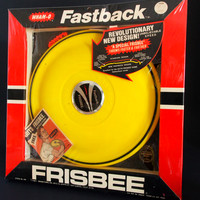
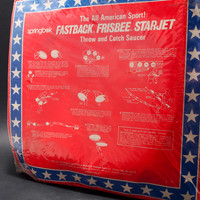
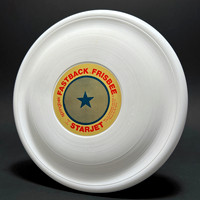
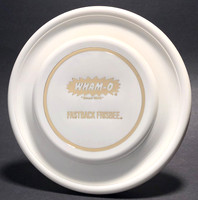
The Fastback was introduced in 1970 by Dick Gillespie of Wham-0 Mfg. Co. The initial use of the mold was in the retail line. The disc was produced only in yellow and was sold in a shadow box packaging.
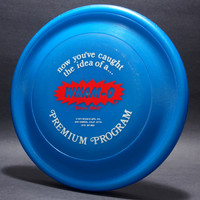
In early 1974, the Wham-0 Premium program began in earnest with the retooling of the Fastback to accommodate a larger imprinting area. The first generation had a mildly rounded crown and was all silkscreen imprints. In 1975, the mold was changed to a square top crown and hot stamped imprint These Fastbacks became known as square tops (and sometimes referred to as flat-tops).
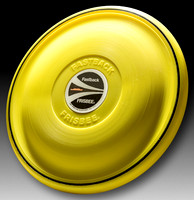
Current production Fastbacks are those that have been molded since the beginning of 1976. Its premier characteristic is a wing-shaped profile, a distinctly curved shoulder, and a conforming curve at the crown shoulder. There are various molds (some are double cavity, meaning two produced at one time), many different colors and hot stamps; the plastic consistency varies and there is definite weight variation. But the basic flight characteristics and design are the same.
Premium Fastback Frisbee discs are sometimes available at common retail stores, but have been primarily distributed nationally and internationally through schools, banks, radio stations, airlines, and a wide variety of different programs.
While the Fastback was created primarily as a retail sales tool, professional disc players began to adapt this disc to two Frisbee disc games, Maximum Time Aloft (M.T.A.) and Throw, Run, and Catch (T.R. & C.). Tom McRann of Northern California began throwing the Fastback in competition in 1976 and within a year, 75% of the M.T.A. and T.R. & C. players were using the Fastback.
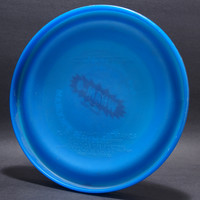
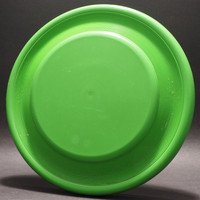
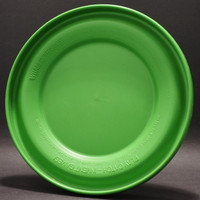
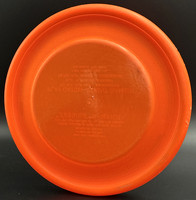
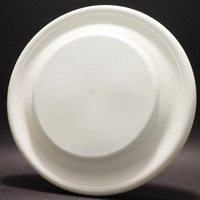
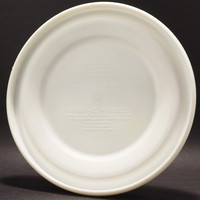
The tooling on the bottom of the Fastback has changed over the years as well. The FDM will eventually adopt the tooling letters A, B and C as described in this newsletter. Here is an excerpt from the Flying Disc Collectors Association newsletter #10, published in 1984. "Right before Christmas 1975 the legend was moved again. This time on the bump around the edge. The T.M. Pats. and flat flip line are in small print. For simplicity I call this type "A" engraving. The WHAM-0 FRISBEE PLAY CATCH-INVENT GAMES line is in bold print. I call this type "B" engraving. In early 1976 an attempt was made to remedy the poor performance problem. The raised center section was lowered a bit and the sharp angles of the bump-groove were smoothed out. The underside was re-engraved in the same style as before with both type A and B engraving. The retooling solved the problem was solved. This configuration, although slightly unstable, was a success. It performs better than all the original prototypes and and is now being used by serious players. A note should be made here about Mr. Ernie "Fastback-" Wilkerson. Because of his efforts the once dormant premium program was quite literally out of control. Discs could not be made fast enough to meet the demand. So, many new molds were made in a short period of time - 18 to be exact. But to my knowledge no mold 2. About March of 1976 Molds 3,4, and 5 surfaced. They received type A and type B engraving. About the end of April molds #6,7 and 8 were introduced. They too had type A and B engraving. There was also a list of all the other flying discs made by Wham-O engraved just inside the rim. This is done in bold flat print. I call this type "C" engraving. At this time molds 1, 2, 3, 4 and 5 received type C engraving also. Molds #9 and #10 showed up about the same time. Curiously, they only received type A engraving. To my knowledge mold 19 was originally used for foreign hot stamp orders and was sent overseas, but recently mold 19 was either retooled, retrieved or resurrected and is now used for normal runs."
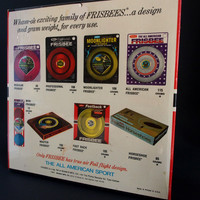
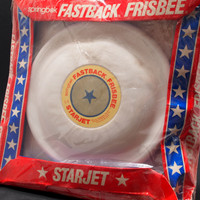
In this gallery you will find Fastbacks that were primarily produced for retail sales. There are also many examples of Fastbacks throughout the museum, especially in the Promotional galleries. All Fastbacks are produced by Wham-O and licensees are seperated with a divider
~Mike Hughes
Photo copyrights belong to their respective contributors, disc design copyrights belong to their designers